Patellar Luxation in Dogs
What is patellar luxation in dogs?
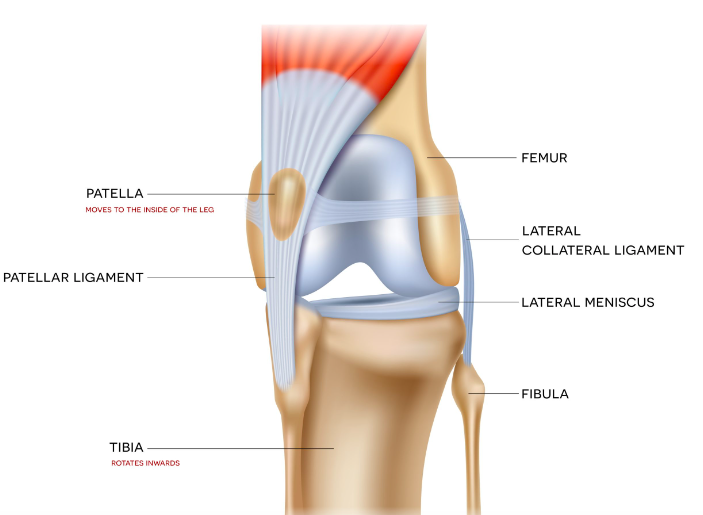
Patellar luxation is a condition affecting the knee that can occur in both dogs and cats. The patella is the kneecap. In dogs with patellar luxation, the kneecap is too loose and can move out of its normal position.
How does a patellar luxation develop in dogs?
The kneecap (patella) is a small bone located within the tendon of the knee. Muscles control the movement of the hind legs and help keep the kneecap in its proper position. When the knee bends and straightens, the kneecap normally glides smoothly along the thigh bone (femur).
The femur has a groove called the trochlear groove, which is shaped to hold the kneecap in place. In some animals, this groove is abnormally shaped or too shallow, allowing the kneecap to slip out of position. This is known as patellar luxation.
Repeated movement of the kneecap out of its normal position can damage the cartilage in the knee joint.
What are the symptoms of patellar luxation in dogs?
When the kneecap slips out of its normal position, the knee can no longer move normally. Your dog may suddenly become lame or start skipping on the affected leg until the kneecap moves back into place.
Causes of patellar luxation
In most cases, abnormalities in the groove of the thigh bone are present from birth. Dogs can also develop a loose kneecap due to an abnormal alignment of the thigh and lower leg bones. This can be partly breed-related. Breeds that may have a hereditary predisposition to patellar luxation include:
- Toy Poodle
- Chihuahua
- Keeshond
- Yorkshire Terrier and Boston Terrier
- Labrador Retriever and Golden Retriever
- Boxer
- Husky
- Akita Inu
There are also causes of patellar luxation that are not present from birth, such as:
- Trauma to the joint capsule, for example following an accident
- Being overweight
- Abnormal alignment of the legs
- Cushing’s disease
Diagnosis of patellar luxation
Patellar luxation can usually be diagnosed through a physical examination of your dog. During the examination, we can also determine the severity of the luxation. Patellar luxation is classified into four grades:
Grade 1: The kneecap can be manually moved out of the groove in the knee joint. When released, it automatically returns to its normal position.
Grade 2: The kneecap moves out of position during certain movements, but can easily be returned to its normal position or moves back on its own.
Grade 3: The kneecap remains out of position and does not return on its own. However, it can still be manually repositioned.
Grade 4: The kneecap remains permanently out of position and cannot be manually repositioned. Surgical correction is required to return it to its normal position.
In some cases, we may recommend X-rays of the knee. These are mainly used to assess changes in the bone and joint, such as the development of osteoarthritis.
Treatment of patellar luxation
The treatment for patellar luxation depends on the severity of the luxation, the symptoms your dog is experiencing and your dog’s overall physical condition.
In dogs with grade 1 patellar luxation, the condition can often be managed successfully with targeted muscle strengthening. For grade 2 luxation, the decision to recommend surgery depends on the level of pain and discomfort your dog experiences. In some cases, appropriate exercise and pain medication may be sufficient.
For grade 3 and 4 patellar luxation, surgery is recommended in most cases. The aim is to correct the luxation and help prevent further joint damage and osteoarthritis. Together with you, we will discuss the potential benefits and risks of surgery and determine the most appropriate treatment for your dog.
What does patellar luxation surgery involve?
All of our clinics have fully equipped operating theatres with state-of-the-art equipment. Our veterinarians also have extensive experience in surgery.
Preparation
It is important that your dog has an empty stomach before surgery. This means that your dog should not eat for 12 hours before the procedure. Anaesthesia can cause animals to vomit, and if they have recently eaten, there is a risk that food could enter the airways. Your dog may continue to drink water.
Please take your dog outside to relieve themselves before bringing them to the clinic. During anaesthesia, dogs can sometimes urinate or pass faeces, which can soil their coat and make it more difficult to maintain good hygiene during surgery. It is also more comfortable for your dog to wake up with a clean coat.
The procedure
Before your dog is anaesthetised, we perform a thorough physical examination to make sure they are healthy enough to undergo surgery. We then place an intravenous catheter in a vein in the front leg. Anaesthetic medication is administered through the catheter, allowing your dog to fall asleep quickly and safely. Once your dog is asleep, we place a breathing tube (endotracheal tube) in the windpipe so that we can provide oxygen and inhaled anaesthetic gases. Your dog is then connected to monitoring equipment. Throughout the procedure, we closely monitor vital parameters such as heart rate, ECG and breathing. Additional intravenous fluids are also given to help maintain blood pressure.
To correct a patellar luxation, the groove in which the kneecap sits needs to be modified so that the kneecap can no longer slip out of position. There are several techniques that can be used to deepen the groove. One of the most reliable techniques is a block recession. During this procedure, the surgeon removes a block of cartilage and underlying bone from the groove. The groove is then deepened, after which the block is placed back into position.
The attachment point of the patellar tendon is also repositioned and secured, together with the cartilage and bone block that was removed earlier. This is done using one or more small metal pins. These keep the bone fragment securely in place and help reduce the abnormal pulling force exerted by the patellar tendon. The soft tissues around the knee are also tightened with sutures, making the entire knee joint more stable.
Recovery and aftercare following patellar luxation surgery
The average recovery time after patellar luxation surgery is six weeks. Your dog can usually go home on the same day as the surgery. The surgeon will call you once we know what time your dog can be collected. You will also receive written instructions explaining exactly how to care for your dog after the procedure.
When collecting your dog, please consider how you will transport them home. Your dog will still be recovering from the anaesthetic and may be drowsy and more susceptible to getting cold. Your dog will also need to have restricted exercise following patellar luxation surgery.
Drinking
After surgery, you can offer your dog small amounts of water. Do not allow them to drink too much at once, as drinking a large amount of water too quickly may cause vomiting.
Eating
A few hours after surgery, you can offer your dog a small amount of food. Start with approximately ¼ of their normal portion, as your dog may still feel nauseous from the anaesthetic. We will provide you with a can of easily digestible food for the first evening.
Medication
Your dog will receive pain-relieving injections before surgery. Some dogs, particularly Retrievers, may become restless or vocal after receiving certain pain medications. This usually resolves on its own.
We will provide pain medication for your dog to take at home. You can start giving this the day after surgery. Even if your dog appears to be pain-free, it is important to continue giving the medication as prescribed, as these medications also help reduce inflammation.
Your dog will also receive antibiotics. It is very important to complete the entire course, even if your dog seems to have recovered.
The wound
We would like to see your dog back at the clinic after seven days for a wound check. There is no charge for this appointment. In the meantime, make sure your dog does not lick or chew the wound. If your dog does try to interfere with the wound, we recommend using a protective collar.
After surgery, you will also receive a hot/cold pack. During the first three days after surgery, you can use it to cool the wound three times a day. Keep the pack in the freezer and always wrap it in a towel before placing it against the wound or operated joint. Apply it for 10 minutes at a time to help reduce swelling.
After these first three days, you can also use the pack warm three times a day. Applying gentle warmth can stimulate blood circulation and support the healing process.
Never use the hot/cold pack directly on the skin. Always wrap it in a towel.
Exercise
You will receive an exercise plan to take home for your dog. In most cases, the schedule is as follows:
- Until the wound check: go outside 3–4 times a day for 5 minutes
- During weeks 3 and 4 after surgery: go outside 3–4 times a day for 10 minutes
- During weeks 5 and 6 after surgery: go outside 3–4 times a day for 15 minutes
In most cases, your dog can gradually return to their normal activities after the six-week check-up.
How much does patellar luxation surgery cost?
The cost of surgery depends on several factors, including your dog’s weight and the severity of the patellar luxation. Would you like an estimate of the costs? Please feel free to contact us for more information.
Orthopaedics
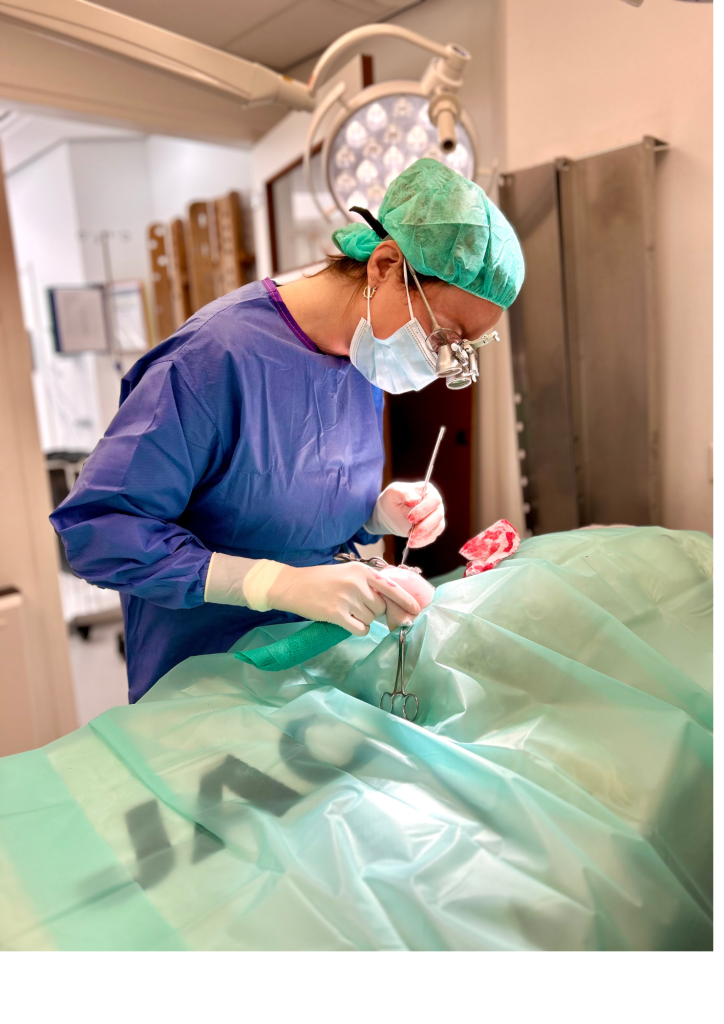
Orthopaedics is an important part of veterinary medicine. Our veterinarian Elsje Peletier has extensive experience in veterinary orthopaedics.
Read more