Torn Cruciate Ligament in Dogs
A torn cruciate ligament is one of the most common causes of knee problems in dogs. Surgery offers a good chance of recovery and can help prevent further damage and osteoarthritis in the knee joint.
What is a torn cruciate ligament?
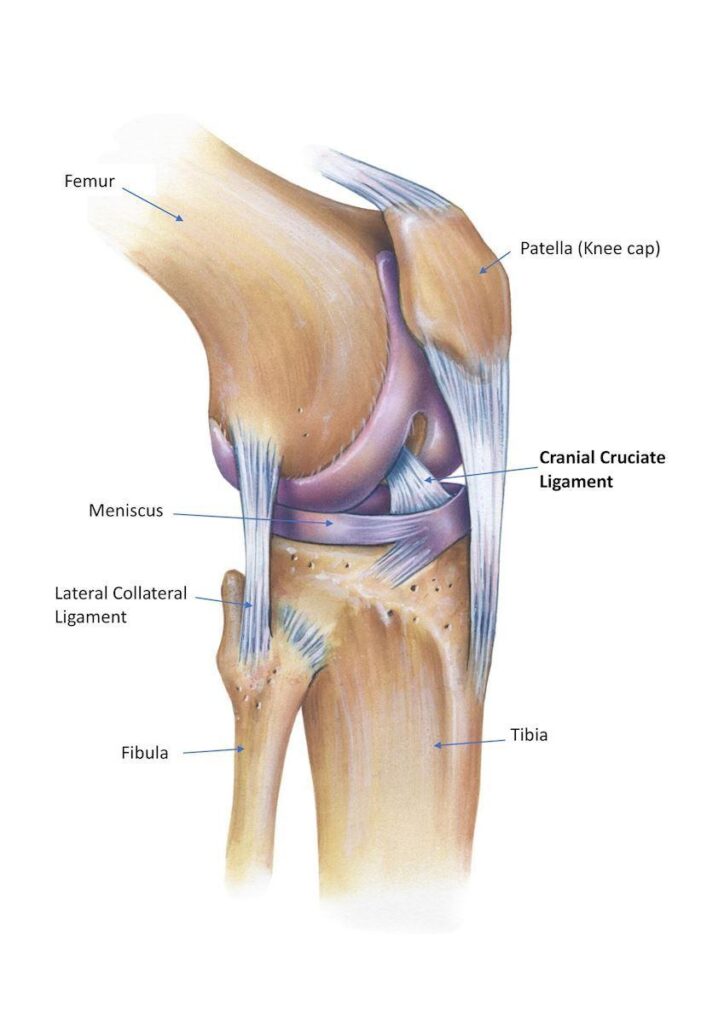
The knee joint connects the thigh bone (femur) to the lower leg bones. It is a complex joint that allows the leg to bend, rotate and move back and forth. The knee contains, among other structures, the cranial cruciate ligament, the caudal cruciate ligament and the kneecap (patella). It also contains two menisci, which are crescent-shaped pieces of cartilage that help cushion and stabilise the joint.
The cruciate ligaments are two bands that cross between the tibia and femur. They help keep these bones stable and prevent excessive movement relative to each other.
When the cranial cruciate ligament tears, the knee becomes unstable. The tibia can move abnormally forward relative to the femur. This instability can also damage the meniscus, which lies between the two bones.
In most cases, it is the cranial cruciate ligament that tears. A tear of the caudal cruciate ligament is much less common.
How can a torn cruciate ligament occur in dogs?
Several factors can contribute to a torn cruciate ligament, including:
- Sudden or abnormal movement: One of the most common causes is a sudden movement involving a combination of overextension and twisting of the knee.
- Genetic predisposition: Some dogs may have a genetic predisposition to developing a cruciate ligament tear.
- Knee conformation: Dogs with a more upright or steeply angled knee may have a relatively shorter cruciate ligament, making it more susceptible to tearing when the knee is overextended.
- Being overweight: The more excess weight a dog carries, the greater the strain on the cruciate ligament, which can increase the risk of a tear.
What are the symptoms of a torn cruciate ligament in dogs?
If your dog has a torn cruciate ligament, you may notice the following symptoms:
- Sudden lameness
- Reluctance or inability to put weight on the affected hind leg
- Swelling around the knee
- Turning the affected leg outward when sitting
- Pain when the knee is touched or moved
Which dog breeds have an increased risk of cruciate ligament tears?
Any dog, whether small or large, can develop a torn cruciate ligament. However, some breeds are more prone to cruciate ligament injuries. This may be related to genetic predisposition, body conformation or other factors that place greater strain on the knee joint.
Breeds that may have an increased risk include:
- Boxers
- Rottweilers
- Chow Chows
- Retrievers
- Bulldogs
- Bull Terriers
- Newfoundlands
Examination and diagnosis of a torn cruciate ligament
Medical history
The information you provide as the owner can often give us an initial indication that your dog may have a torn cruciate ligament. For example, your dog may have been playing, suddenly cried out and then started limping. Your veterinarian will therefore first ask you about what happened and how your dog’s symptoms developed.
Physical examination
During the physical examination, your dog’s gait will be assessed and the knee will be carefully examined and palpated. The veterinarian will also perform a cranial drawer test to assess the stability of the knee. During this test, the movement of the tibia relative to the femur is assessed. Abnormal forward movement of the tibia can indicate a torn cranial cruciate ligament.
Additional diagnostic tests
X-rays may be taken to support the diagnosis and to assess the condition of the knee joint. They can also help rule out other causes of knee problems, such as patellar luxation, and show whether osteoarthritis is present and, if so, how advanced it is.
In some cases, ultrasound or arthroscopy may also provide additional information and help with the diagnosis.
Treatment of a torn cruciate ligament
In some cases, a torn cruciate ligament can be managed conservatively with rest and pain relief. This may be an option for small dogs weighing less than 10 kg, provided there is no damage to the meniscus. In larger dogs, the knee is much more likely to remain unstable despite rest and pain medication.
In most cases, surgery is therefore recommended for a torn cruciate ligament. With appropriate surgical treatment, the outlook for restoring normal, pain-free function of the knee is generally good.
Types of surgery for a torn cruciate ligament
Surgery for a torn cranial cruciate ligament aims to stabilise the knee and restore its normal function. During surgery, damaged remnants of the torn cruciate ligament and, if necessary, damaged parts of the meniscus are removed.
There are several surgical techniques that can be used to treat a torn cranial cruciate ligament. Your veterinarian will discuss the different options with you and recommend the technique that is most suitable for your dog.
TTA and TTA Rapid – Tibial Tuberosity Advancement
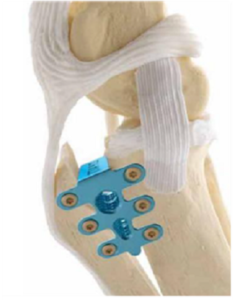
With both TTA and TTA Rapid surgery, the front part of the tibia (tibial tuberosity) is cut and moved forward. This increases tension in the patellar ligament. The resulting change in the mechanics of the knee prevents excessive forward movement of the tibia during weight-bearing, providing stability in the knee that would otherwise be provided by the cranial cruciate ligament.
With conventional TTA, the tibial tuberosity is completely cut and stabilised using a titanium cage and a plate. With TTA Rapid, the cut does not extend all the way through the bone, which means that a plate is not required and only a titanium cage is placed. The cage used for TTA Rapid is larger and longer than the one used for conventional TTA. Both techniques are considered effective surgical options.
The gap created in the bone gradually fills with new bone and typically heals within two to four months. The titanium cage and, where applicable, the plate remain permanently in place.
TPLO – Tibial Plateau Levelling Osteotomy
The TPLO technique changes the angle of the top of the tibia (tibial plateau) to stabilise the knee during weight-bearing. This is done by making a curved, circular cut through the upper part of the tibia. The bone segment is then rotated to change the angle of the joint surface from sloping to a more level position and secured with a bone plate.
By changing the angle of the tibial plateau, the forces acting on the knee during weight-bearing are altered, providing stability despite the absence of the cranial cruciate ligament.
Fibre wire technique
With this technique, a nylon loop is placed around the knee to provide additional stability. The fibre wire acts as a replacement for the function of the cruciate ligament, helping the femur and tibia move more naturally relative to each other.
This technique is mainly used in smaller dogs.
How does cruciate ligament surgery work?
All of our clinics have fully equipped operating rooms with state-of-the-art equipment. Our veterinarians also have extensive experience in surgery.
Preparation
It is important that your dog has an empty stomach before surgery. This means that your dog should not eat for 12 hours before the procedure. Anaesthesia can cause animals to vomit, and if they have recently eaten, there is a risk that food or stomach contents could enter the airways. Your dog may continue to drink water.
Please take your dog outside to relieve themselves before bringing them to the clinic. During anaesthesia, dogs can sometimes urinate or pass faeces, which can soil their coat and make it more difficult to maintain good hygiene during surgery. It is also more comfortable for your dog to wake up with a clean coat.
The procedure
Before your dog is anaesthetised, we perform a thorough physical examination to make sure they are healthy enough to undergo surgery. We then place an intravenous catheter in a vein in the front leg. Anaesthetic medication is administered through the catheter, allowing your dog to fall asleep quickly and safely. Once your dog is asleep, we place a breathing tube (endotracheal tube) in the windpipe so that we can provide oxygen and inhaled anaesthetic gases. Your dog is then connected to monitoring equipment. Throughout the procedure, we closely monitor vital parameters such as heart rate, ECG and breathing. Additional intravenous fluids are also given to help maintain blood pressure.
Depending on your dog’s individual situation, we will use one of the surgical techniques discussed above:
- TTA or TTA Rapid
- TPLO
- Fibre wire technique
Recovery and aftercare following cruciate ligament surgery
The average recovery time following cranial cruciate ligament surgery is approximately 8 to 10 weeks. Your dog can usually go home on the same day as the surgery. The surgeon will call you once we know what time your dog can be collected. You will also receive written instructions explaining exactly how to care for your dog after the procedure.
When collecting your dog, please consider how you will transport them home. Your dog will still be recovering from the anaesthetic and may be drowsy and more susceptible to getting cold. Your dog will also need to have restricted exercise following cruciate ligament surgery.
Drinking
After surgery, you can offer your dog small amounts of water. Do not allow them to drink too much at once, as drinking a large amount of water too quickly may cause vomiting.
Eating
A few hours after surgery, you can offer your dog a small amount of food. Start with approximately ¼ of their normal portion, as your dog may still feel nauseous from the anaesthetic. We will provide you with a can of easily digestible food for the first evening.
Medication
Your dog will receive pain-relieving injections before surgery. Some dogs, particularly Retrievers, may become restless or vocal after receiving certain pain medications. This usually resolves on its own.
We will provide pain medication for your dog to take at home. You can start giving this the day after surgery. Even if your dog appears to be pain-free, it is important to continue giving the medication as prescribed, as these medications also help reduce inflammation.
Your dog will also receive antibiotics. It is very important to complete the entire course as prescribed.
The wound
We would like to see your dog back at the clinic after 7–10 days for a wound check. There is no charge for this appointment. In the meantime, make sure your dog does not lick or interfere with the wound. If your dog does try to do so, we recommend using a protective collar.
After surgery, you will also receive a hot/cold pack. During the first three days after surgery, you can use it to cool the wound three times a day. Keep the pack in the freezer and always wrap it in a towel before placing it against the wound or operated joint. Apply it for 10 minutes at a time.
After these first three days, you can also use the pack warm three times a day. Applying gentle warmth can stimulate blood circulation and support the healing process.
Never use the hot/cold pack directly on the skin. Always wrap it in a towel.
Exercise
You will receive an exercise plan to take home for your dog. In most cases, the schedule is as follows:
- Until the wound check: go outside 3–4 times a day for 5 minutes
- During weeks 3 and 4 after surgery: go outside 3–4 times a day for 10 minutes
- During weeks 5 and 6 after surgery: go outside 3–4 times a day for 15 minutes
After this, your dog will have another check-up. During this appointment, we will assess the progress of the recovery and advise you on the final stage of rehabilitation.
How much does cruciate ligament surgery cost?
The cost of surgery depends on several factors, including your dog’s weight and the surgical technique used. Would you like to receive a price estimate? Please feel free to contact us for more information.
Orthopaedics
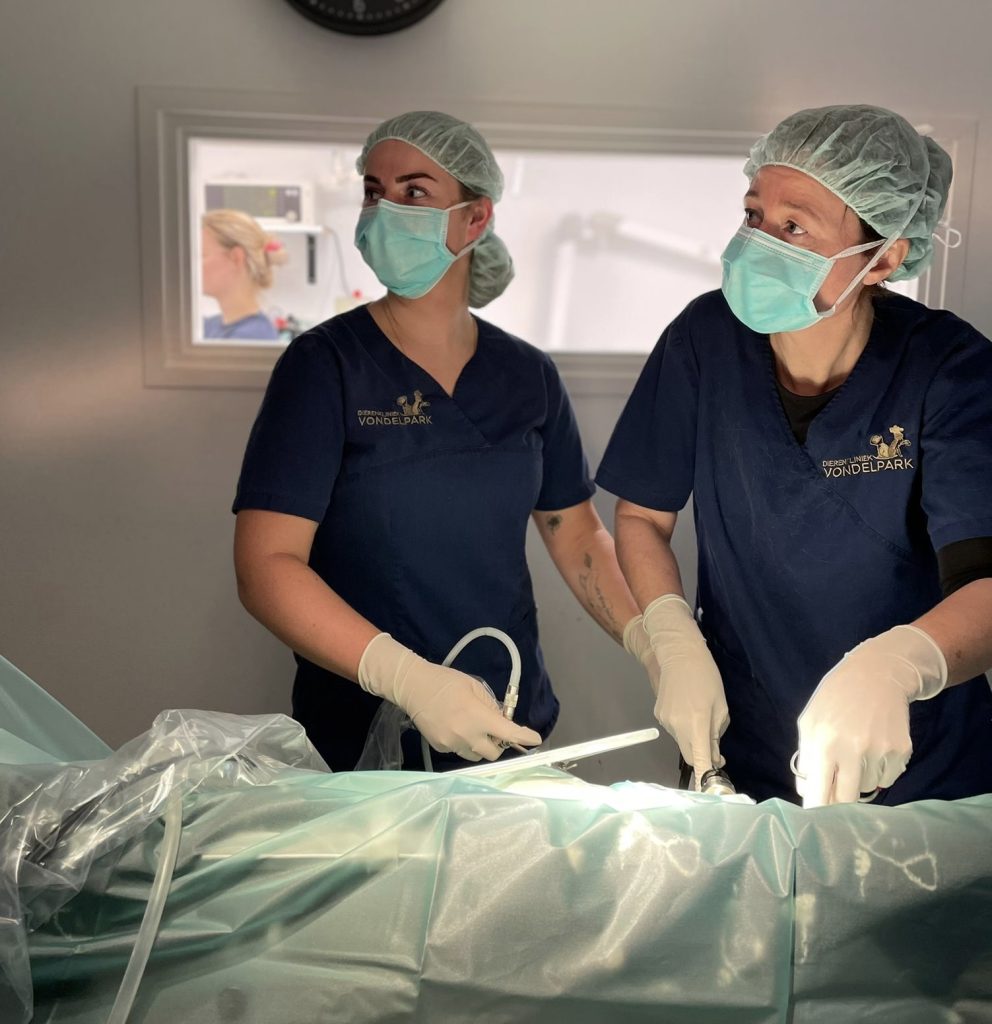
Our veterinarians have extensive experience in orthopaedic surgery, and we perform a range of orthopaedic procedures at De Dierenkliniek. Find out more about our orthopaedic services.