Spaying Your Rabbit
Why Choose to Spay Your Rabbit?
We recommend spaying a female rabbit, also known as a doe. Besides preventing pregnancy, spaying offers several important health benefits.
The reasons to spay your rabbit include:
- Prevention of uterine cancer: From around 4 years of age, 50–80% of unspayed female rabbits develop some form of uterine cancer. These tumors are malignant and can spread to other parts of the body.
- Prevention of other ovarian and uterine disorders
- Prevention of mammary gland tumors
- Avoidance of unwanted pregnancy and false pregnancy
From What Age Can a Rabbit Be Spayed?
We recommend having your rabbit spayed from a minimum age of 5 months up to a maximum of 2 years. During the spaying procedure, the ovaries and the entire uterus are removed.
Post-operative care
It is very important that your rabbit continues to eat normally before the surgery. She should not be fasted! For rabbits, it is crucial that their digestive system keeps moving. The reason other animals and humans must fast is to prevent vomiting during anesthesia. Rabbits, however, cannot vomit, so this risk does not apply to them.
We ask that you bring some of your rabbit’s usual food on the day of the surgery to ensure she continues eating comfortably while at our clinic. Additionally, if your rabbit lives with another rabbit, please bring her companion as well. Rabbits recover faster from anesthesia and experience less stress when they have a familiar friend nearby.
The surgery
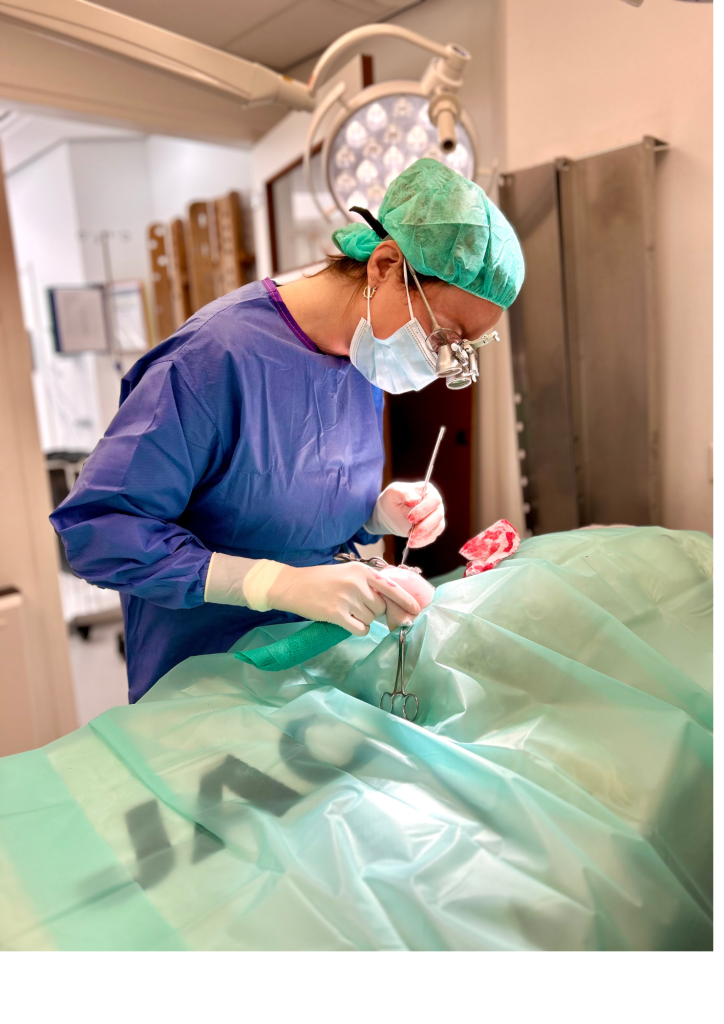
At all our locations, we follow the latest knowledge and techniques to perform the surgery as safely as possible. Our surgical procedures are carried out at a high professional standard.
Before starting the operation, your rabbit will first undergo a physical examination. If no issues are detected, your rabbit will be placed under anesthesia. Once she is asleep, a tube will be inserted into her airway to connect her to ventilation, gas anesthesia, and monitoring equipment. An intravenous line will also be placed so we can provide fluid therapy during the surgery. In addition, your rabbit will receive pain relief and an injection to keep her digestive system active during anesthesia.
While your rabbit is asleep and connected to the monitor, she will be placed on a warming mat to maintain her body temperature throughout the procedure. The surgical area will then be shaved and sterilized. Your rabbit’s condition will be continuously monitored during the surgery.
After the operation is complete, your rabbit will receive an injection to reverse the anesthesia. This helps her wake up quickly and return to her comfortable, warm enclosure to recover. The veterinarian will contact you to provide an update on how the surgery went. Your rabbit can go home once her temperature is stable, she is eating well, and she is active again.
Aftercare
Once your rabbit is home, it is important that she continues to recover in a warm, quiet environment. Because of the surgical wound, your rabbit should not be on bedding made of straw, hay, or wood shavings, as this can irritate the wound. Instead, place a clean towel or other soft mat on the bottom of the enclosure. Keep a close eye to ensure that your rabbit continues to eat and produce droppings.
We will call you the day after the surgery to check on your rabbit’s progress. If you have any doubts or questions in the meantime, please do not hesitate to contact us.
Also interesting
Surgery at De Dierenkliniek
Our vets have a wealth of experience a broad range of surgeries. This enables us to offer you all possible surgeries in-house. Our clinics are equipped with state-of-the-art operating theatres and modern equipment.